

anchoring in safety
a practice of building resilience amidst discomfort

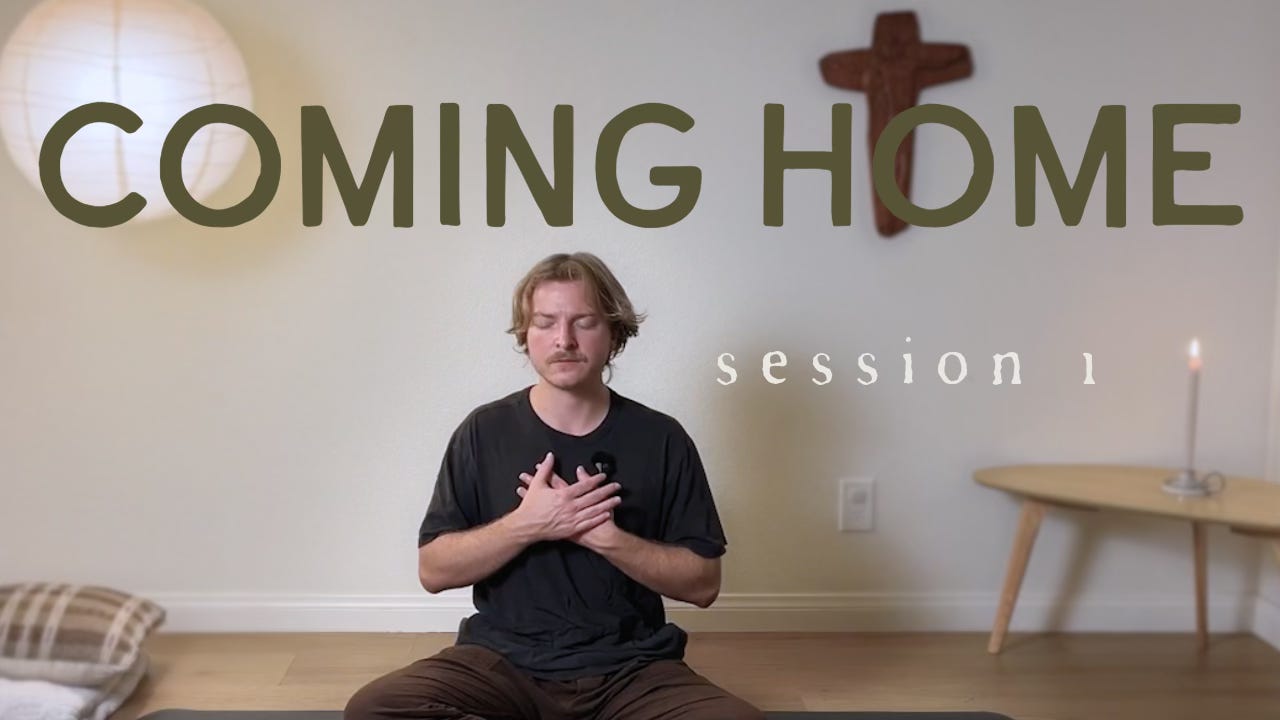
Welcome to the first session of Coming Home, a 5-part series introducing my process of incarnational healing.
Over the coming weeks and months, I'll be rereleasing each session here in a more intimate format on Grace in the Flesh. Whether you merely glanced at the program or have already worked through it, this series will be an opportunity to move through each session slowly and intentionally so you can peel away from the noise and back to the interface of your inner life. You’ll be accompanied by my commentary and revisions that expand on the original reflection and practice recordings.
Coming Home was created for the curious, weary, and heavy-hearted. For those longing to feel more alive and connected to themselves and their loved ones beyond hardship, and to become more receptive to the presence of God within the ordinary realities of human life.
If you’re new here, Grace in the Flesh is my monthly-ish newsletter where I write from the heart to the one’s aching to feel at home in their own skin again. Thank you for reading, commenting, sharing, and being here with your time and presence.
introduction
I want to begin by sharing a brief introduction to Coming Home and the heart behind this series for me.
When I first created Coming Home, I was noticing a common pattern in both my own life and my work with others. So many of us were trying to heal primarily through understanding.
We read the books. Listened to podcasts. We prayed more fervently. Analyzed our symptoms. Learned the psychological theories to explain ourselves better than ever before.
Yet somehow we still felt distant from ourselves.
For many of us, survival required becoming disconnected from the body. We learned to live from the neck up. We became experts at managing life through thinking, striving, controlling, performing, intellectualizing, or even spiritualizing our pain.
The body, however, remembers what the mind forgets.
And healing often begins again (in a deeper way) not by figuring ourselves out through more analysis, but by gently returning to the landscape within. By going deeper with less information, not more.
Before we reflect further, I want to mention that Grace in the Flesh is largely a labor of love.
My hope is to keep the Coming Home series freely available so that anyone who feels drawn to this work can access it. If you find these reflections, practices, and resources meaningful, I would be grateful if you would consider becoming a paid subscriber.
Your support helps sustain the time and energy required to continue writing, creating, and sharing this work with others.
the reflection.
If there is one idea I hope you take from this first session, it is this:
Safety, not comfort, precedes transformation.
Well… that is the punchier, edgier way to say it… but honestly as I think about what would be a more truthful way to say that, I’ve discovered that among other things, safety often precedes transformation. Safety is not the only requirement for change, but it sure is important, and if that’s not present, it’s very hard to see honest progress without fooling yourself over a long period of time.
Many of us want relief as quickly as possible. We want the anxiety to flicker and die. The compulsions to be extinct. The numbness melted away. Shame… dissolved.
However, healing rarely begins there.
Instead, healing passes into a new beginning, beyond a threshold of the illusory control of the mind, so to speak, by helping the body discover that it is safe enough to remain present to a felt sense of the unknown… what cannot be grasped at… but only received.
This is why trauma work can feel so frustrating. We often want to jump immediately into our wounds, our memories, our emotions, and our stories. Yet the nervous system frequently cannot sustain contact with those realities without becoming overwhelmed.
So we learn to avoid. Numb. Dissociate. Or obsess. Micromanage. Control. Endlessly thinking about our feelings rather than actually feel them.
And I speak from experience when I say,
your body is not your enemy in this process. It is often the frightened messenger carrying burdens it was never meant to carry alone.
One line from the recorded reflection continues to stay with me:
Self-regulation depends on having a friendly relationship with your body.
For many people, that sentence feels almost foreign.
A friendly relationship with the body?! What?!
Yep.
Not a controlling relationship. Not a critical relationship. Not a suspicious relationship. Not a relationship based solely on fixing symptoms…
a friendship…
a partnership…
a home.
So the following practice is less about healing your deepest wounds and more about establishing a safe place from which healing can eventually unfold.
We’ll do this today by incorporating simple physiological activation to settle any pent-up hyper-vigilance, then grounding, more resource building through movement, visceral visualization anchoring, and somatic awareness of your body’s internal sense of calm and peace so you begin to feel the difference between survival mode and supported presence.
Last thing I’ll say before we practice together.
Sometimes the first grace is simply learning that safety can still be found somewhere within us.
Even if only in small glimmers.
Even if only for a few moments at a time.
And for today, that is enough.
the practice.
The practice for this session may feel surprisingly simple.
That simplicity is intentional.
Many of us have spent years trying to heal through effort. Through intensity. Through forcing change.
Yet the body often responds differently.
And the nervous system frequently heals through experiences that are repetitive, gentle, embodied, relational.
One thing I would encourage you to notice throughout this practice is that safety does not necessarily mean the absence of discomfort.
You may still feel anxious.
You may still feel numb.
You may still notice grief, fear, sadness, anger, or resistance.
The goal is not to eliminate those experiences.
The goal is to discover that alongside them, there may also be a small place where safety exists.
A softening in the shoulders. Or maybe a warmth in the chest. A deepening breath. A sense of being held firmly by the floor beneath you. Maybe even a glimpse of God’s presence.
Because one of the most important insights in trauma recovery is that we can learn to hold both.
Threat and safety.
Fear and peace.
Pain and consolation.
That’s living with enough tolerance for the ‘greyscale of life’ without collapsing into black and white ways of thinking and relating.
In other words, ‘the work’ of healing is not to gaslight one in a feverish validation of the other. That’s never authentic.
It is to gradually increase our capacity to steadily remain present to both.
As you move through the practice, don’t worry about doing it perfectly.
Rather, pay close attention to what helps you feel more grounded. Even just a little.
Go slow, close your eyes (when you can), and notice which movements, postures, images, prayers, or sensations bring even the slightest sense of settling.
Then write them down. Return to them when you could use a breath above the waters of your trials.
These become resources…
and anchors.
Small beacons of light shining the way back home when life becomes overwhelming. And if all you found today was the tiniest glimmer of safety, that is more than enough. That is where we begin.
See you in a few weeks for session two.
upcoming events
Our summer Incarno cohort is currently underway and thriving. It has been a gift to witness participants courageously showing up for healing, growth, and deeper connection with God, themselves, and one another.
Because space is limited and interest continues to grow, I’m already preparing for the fall cohort. If you’d like to learn more when registration opens, you’re welcome to join the waitlist below.
Joining the waitlist does not commit you to participating. It simply ensures you’ll receive details and have early access to registration when enrollment opens.
thank you
As we close this first session, I simply want to thank you for being here.
In a world that constantly asks us to move faster, produce more, and stay distracted, choosing to slow down and attend to your inner life is both revolutionary and a life raft.
If Grace in the Flesh has been a meaningful companion on your journey, I would be honored if you considered becoming a paid subscriber. Your support helps make it possible for me to continue writing these reflections, creating practices like Coming Home, and sharing future resources while keeping much of this work freely available to others.
Whether you support financially or simply continue reading, sharing, and engaging with these letters, thank you.
I’m grateful to be walking this path with you.
With care,
Kolbe
If you just moved through session one with me, this is a taste of who I am and how I work. I’m sensitive, deep, and devoted to finding ways for us to heal and find peace and aliveness in the midst of our imperfect, messy, and unfolding journeys. What you experienced here is a lot of what I’m very passionate about and will often explore in more depth within psychotherapy or mentorship containers with clients.
Whether you’re dealing with chronic pain, chronic people pleasing, perfectionism, compulsive behaviors, dissociation, anxiety, or complex trauma, these are the kinds of issues I’ve had both clinical and personal experience in integrating for myself and others. If you’d like to learn more about me, my story, and my work, I welcome you to hop on over to my website and take a look there
what I’m listening to
Two songs for you today.
“Borne,” by Goose on their record, Dripfield, has been a sure companion of atmospheric optimism during my writing.
And if you’re wanting some ambient catharsis, I’ve lately been turning to M83’s “Wait” on their album, Hurry Up, We’re Dreaming.
what I’ve been reading recently
“Into your hands, Father: Abandoning ourselves to the God who loves us” by Wilfred Stinissen
“A book of coffee, a philosophy” by Julian Baggini and James Hoffmann
“The Wild Edge of Sorrow” by Francis Weller
“Thomas Merton’s path to the Palace of Nowhere” by James Finley
If you would like the reading list that inspires a lot of my work, head on over to my resource page here.
what I’m sipping
After my morning cup, I often turn to a decaf by Canyon Coffee and have been brewing it as a pour-over-ice.
Shoot me a message if you want the recipe. Also, free 15 minute virtual coffee with me if you can tell me which Bluey episode is playing in the background.